
Governance Framework
ARIA: Deterministic Governance for AI Systems
Every decision traced. Every output bounded. Every result reproducible. ARIA is a governed decision engine built on a Coupled Field Model substrate — producing auditable gate decisions with cryptographic evidence bundles, not probabilistic guesses.
A brain-inspired governance architecture. Not a neural network — a bounded dynamical system where every decision is deterministic, every output is auditable, and every result is reproducible.
Overview
What is ARIA?
ARIA Is:
- A deterministic governance engine that produces auditable gate decisions (ALLOW / DAMPEN / BLOCK)
- Built on a Coupled Field Model (CFM) substrate with φ-derived parameters — all state bounded in [0, 1]
- Every decision includes a cryptographic evidence bundle with audit hash, state hash, and replay token
- A 19-stage SystemTickCoordinator pipeline with deterministic execution provenance
ARIA Is Not:
- Not a chatbot, language model, or text-generation system
- Not a probabilistic classifier — decisions come from threshold comparisons on measured state
- Not dependent on external LLM calls for governance decisions (ENABLE_RENDER=0 mode)
Scope: This site describes the ARIA governance engine (deterministic decision pipeline + evidence bundles). The underlying CFM substrate is a numeric dynamical system with bounded state variables. ARIA does not generate natural language — when LLM rendering is enabled, an external provider is called after the governance gate, and the rendered output is subject to claim verification.
The Short Version
What ARIA Is (In One Page)
ARIA is a deterministic governance engine for AI systems. It does not generate text, predict tokens, or make probabilistic guesses. Instead, it evaluates every input through a fixed, reproducible pipeline and produces a gate decision — ALLOW, DAMPEN, or BLOCK — backed by a cryptographic evidence bundle.
The engine is built on a Coupled Field Model (CFM) substrate: 11 numeric state variables organized into 5 coupled channels (Coherence, Energy, Stability, Phase, Alignment). All variables are bounded in [0, 1] by construction — enforced through bounded nonlinearities, hard clamping, and NaN/Inf replacement at every computation step.
When an input arrives, it passes through a 19-stage SystemTickCoordinator pipeline. Each stage reads from and writes to the shared state vector. Gate thresholds are derived from the golden ratio (ALLOW at φ¹ ≈ 0.618, DAMPEN at φ² ≈ 0.382, BLOCK at φ³ ≈ 0.236). The final decision is a threshold comparison — not a learned classifier, not a weighted vote, not an LLM call.
Every decision produces an evidence bundle: audit hash, state hash, truth hash, reason codes, and execution provenance trace. Given identical inputs and initial state, the system produces identical outputs — verifiable through deterministic replay.
Pipeline
How It Works — 5 Deterministic Steps
Ingest
Input is received, normalized, and assigned a request fingerprint. No transformation — just measurement.
Measure
The 19-stage pipeline evaluates the input against current state. All 11 CFM variables are updated deterministically.
Evaluate
Gate thresholds are compared against measured coherence. The decision is a numeric comparison, not a prediction.
Decide
ALLOW, DAMPEN, or BLOCK is emitted with reason codes. If LLM rendering is enabled, it runs after the gate — never before.
Record
An evidence bundle is sealed: audit hash, state snapshot, truth hash, and replay token for independent verification.
Core Principles
Designed for Scientific Rigor
ARIA is built on foundational principles that ensure reproducibility, stability, and meaningful analysis of emergent behavior.
Governed Decisions
Every input is evaluated through a 19-stage deterministic pipeline. Gate decisions (ALLOW / DAMPEN / BLOCK) are threshold comparisons on measured state — not predictions.
Bounded State
All 11 state variables remain strictly bounded in [0, 1]. Five coupled channels (Coherence, Energy, Stability, Phase, Alignment) with cross-channel resonant dynamics.
Deterministic Replay
Given identical inputs and initial conditions, ARIA produces identical outputs. Every decision includes an audit hash and replay token for independent verification.
Evidence Bundles
Each gate decision is accompanied by a cryptographic evidence bundle: audit hash, state hash, reason codes, and execution provenance trace.
Architecture
Multi-Layer Abstraction Stack
The system comprises 3 CFM substrate layers and 5 ARIA abstraction layers. Each layer wraps and extends the previous, transforming lower-level patterns while preserving boundedness and determinism.
CFM Substrate
v0–v2Coupled Field Model with 5 channels (Coherence, Energy, Stability, Phase, Alignment), cross-channel resonant coupling, and a 5-tier φ-derived timescale hierarchy.
ARIA v0
Latent Concept ChannelsProjects CFM state into a 5D latent space with 4 attractor clusters. Stability-gated reinforcement drives states toward dominant attractors.
ARIA v1
Proto-Symbolic LayerDiscretizes latent space into K=8 prototype patterns with soft activations, temporal stabilization via EMA, and hysteresis to prevent jitter.
ARIA v2
System State VectorAggregates state from all underlying layers into a 12D normalized summary with adaptive smoothing and drift detection.
ARIA v3
Relational GraphBuilds an 8×8 relation matrix tracking symbol co-activation and transition patterns with state-gated plasticity.
ARIA v4
Proto-Semantic CodesIntegrates v1/v2/v3 patterns into M=16 anonymous codes. Very slow plasticity (η ≈ φ⁻⁵) enables gradual structure formation.
Visualization
Observe Emergent Patterns
Stable patterns emerge from coupled oscillator dynamics without explicit training. All visualizations are derived from saved simulation data.
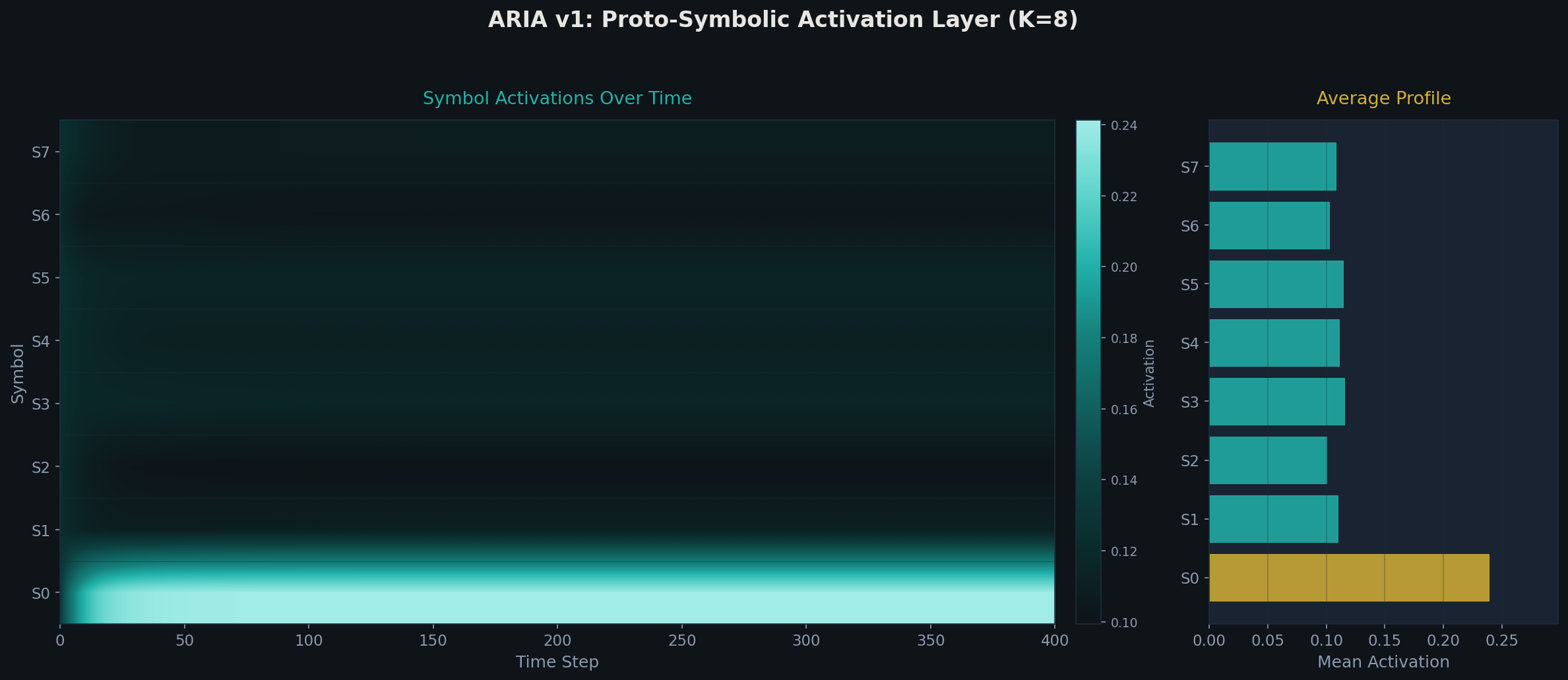
ARIA v1: 8 prototype patterns (K=8) with soft activations over time
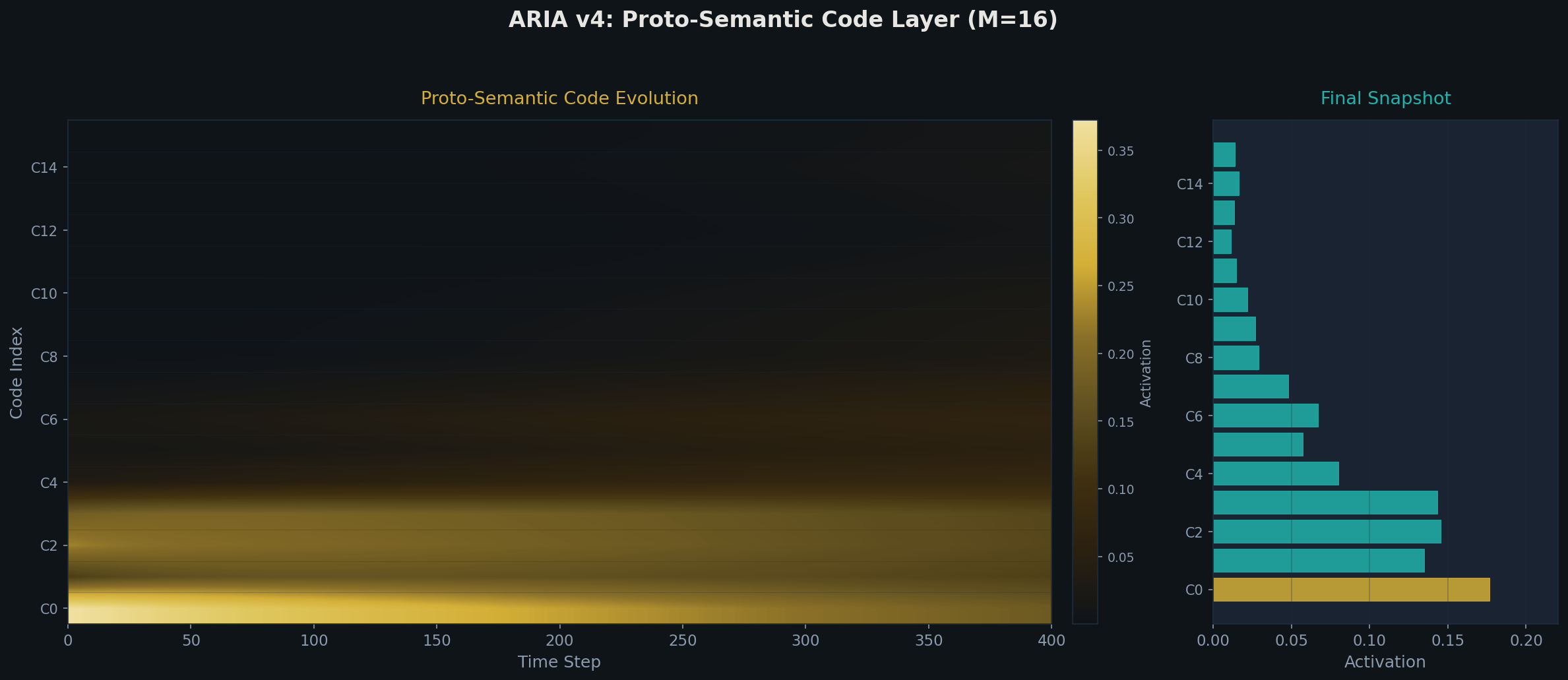
ARIA v4: 16 anonymous codes (M=16) compressing multi-layer patterns
See It Work
The live demo runs the full 12-step governance pressure sequence. Watch gate decisions change from ALLOW to DAMPEN to BLOCK as measured state metrics cross thresholds — then recover. Every step produces a verifiable evidence bundle.
Audience
Who This Is For
AI Safety Researchers
Study a governance architecture where every decision is deterministic, every state variable is bounded, and every output includes a verifiable evidence trail. No black-box classifiers — inspect the full 19-stage pipeline.
Systems Engineers
Integrate a governance layer that operates through numeric state measurement, not probabilistic inference. Bounded state, deterministic replay, and cryptographic evidence bundles provide the guarantees production systems require.
Governance & Compliance Teams
Audit AI decision-making with complete evidence bundles: gate decisions, state snapshots, reason codes, and replay tokens. Every decision is reproducible and independently verifiable — not a summary or approximation.